Can A Christian Conservative Support ICE? Yes, and Here’s Why
Wesley King • January 14, 2026
Can A Christian Conservative Support ICE? Yes, and Here’s Why
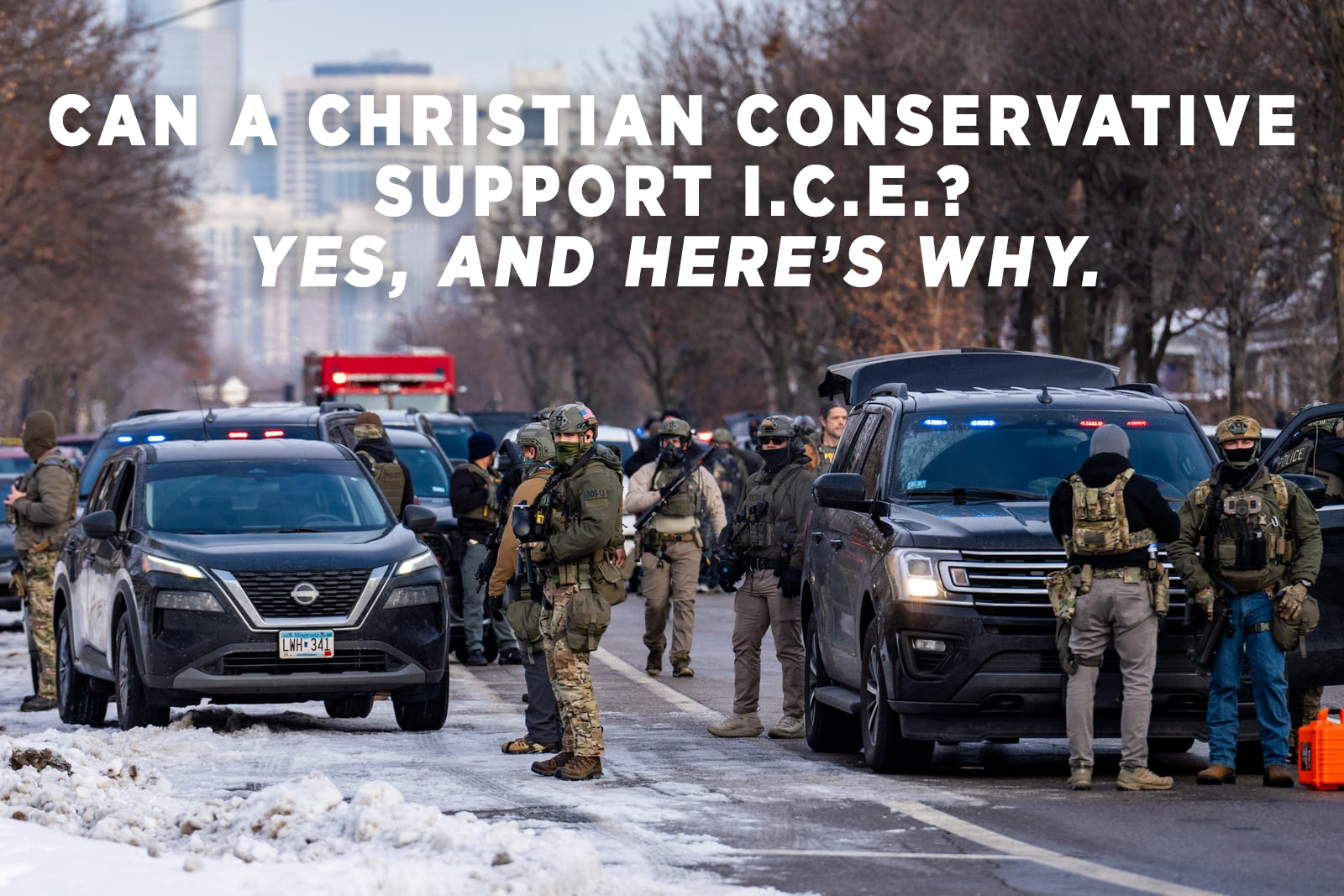
Can a Christian conservative support ICE and its ongoing operations?
The short answer is yes, but let’s look more into it, because this isn’t just a political question. It’s a question about justice, order, human dignity, and what a nation is actually responsible to do.
As Christians and as citizens of the United States, we believe that our government has a right, duty, and responsibility to:
• Defend what’s rightfully ours (sovereignty, security, lawful order)
• Punish evildoers (those who harm, exploit, traffic, and prey on the vulnerable)
• Protect the vulnerable (including citizens, lawful immigrants, and those exploited by criminal networks)
That’s not radical. It’s not “mean.” It’s the basic job description of civil authority in a fallen world.
1) The Biblical Case: Civil Government Has A God-Given Role
A lot of Christians get nervous anytime government uses force. That’s understandable, as history gives plenty of reasons to be cautious. But Scripture doesn’t treat government as an accident. It treats civil authority as a real institution with real responsibilities.
Romans 13:1-6 lays out the framework clearly: civil government is ordained by God to preserve order and restrain wrongdoing. In other words, government is not God, but it is accountable to God — especially for whether it rewards good, restrains evil, and carries out justice.
That matters here, because immigration enforcement isn’t “Christian vs. unchristian.” It’s law vs. lawlessness, order vs. chaos, justice vs. exploitation. Supporting lawful enforcement (including ICE operations) can be consistent with a biblical worldview because government does not exist merely to “feel compassionate.” Government exists to do justice — and justice requires enforceable law.
That’s not compromise. That’s righteousness.
2) The Constitutional Case: Safety and Order Are Core Purposes of the Union
If you’re a constitutional conservative, this part should be straightforward: the Constitution assumes a government that actually governs.
The Constitution’s purpose is framed up front in the Preamble: to form a more perfect union, establish justice, ensure domestic tranquility, provide for the common defense, promote the general welfare, and secure the blessings of liberty. That’s not just poetic language. It’s a statement of what government exists to do: maintain a lawful society where citizens can live in peace, and where threats — foreign and domestic — are addressed.
And the Constitution doesn’t just state the goals. It assigns powers and responsibilities:
• Article I, Section 8 gives Congress authority to legislate in ways that support national security and orderly national life (including matters tied to national defense and the framework for lawful membership/citizenship).
• Article II charges the executive branch with enforcing the law — faithfully executing the laws that are passed.
• Article IV, Section 4 includes the federal responsibility to protect states against invasion and preserve stability.
You don’t have to love every policy choice to acknowledge the baseline: a nation has the right to define its borders, enforce its laws, and maintain internal order. That’s not extremism. That’s sovereignty.
3) The Logical Case: Law Without Enforcement Isn’t Law
Even if you set Scripture and the Constitution on the shelf for a second, basic logic still holds:
• If laws aren’t enforced, they become suggestions.
• If borders aren’t respected, sovereignty becomes a slogan.
• If entry and residence have no standards, legal immigration becomes meaningless.
• If the system collapses into chaos, the vulnerable suffer first.
This is where the conversation gets real. Because the consequences of disorder are not imaginary:
• Criminal organizations exploit porous systems.
• Trafficking becomes easier.
• Local communities absorb strain in schools, healthcare, and housing.
• Working-class wages are pressured.
• Lawful immigrants — those who followed the process — are treated like fools.
The “compassion” narrative often skips this part, but it’s unavoidable: a broken system doesn’t produce mercy. It produces a marketplace where the cartels become the middlemen.
So yes, supporting enforcement is logical because order is the foundation for anything humane to exist at scale. Compassion without order doesn’t stay compassion for long. It becomes confusion, then resentment, then backlash.
One of the strongest arguments for ICE, properly operating, is the ability to focus enforcement on those who pose real danger — because weak enforcement doesn’t eliminate harm; it spreads it.
That’s a position rooted in Scripture, consistent with constitutional government, and aligned with common sense.
So, can a Christian conservative support ICE and ongoing operations?
Yes.
Because:
• Biblically, civil government is ordained to restrain evil and uphold order (Romans 13:1–6).
• Constitutionally, the federal government exists to establish justice, ensure domestic tranquility, provide for the common defense, and execute the laws.
• Logically, law without enforcement is meaningless, and disorder harms the vulnerable most.
Justice and mercy are not enemies. In a healthy nation, mercy is made possible by order, and order is sustained by justice.

Sunday mornings are not a “public forum.” They are a holy appointment. On Sunday, January 18, 2026, an anti-ICE group entered Cities Church in St. Paul (Twin Cities area) during a worship service, loudly chanting and moving toward the front — an invasion that rattled congregants and disrupted prayer and preaching. Reports also note that Don Lemon was present and livestreamed parts of what happened. The church has publicly weighed legal options, and federal officials have said the incident is under investigation and that violations of federal law will be prosecuted. Whether you agree or disagree with a pastor’s day job, a church’s theology, or the politics of the moment, storming a worship service is not “activism.” It is intimidation — aimed not at a government office, but at a gathering of believers seeking to worship God in peace. And that is exactly why this moment matters for every church in America. What “Corporate Worship” Actually Means, and Why It’s Sacred When Christians talk about corporate worship, we don’t mean “corporate” like a business. We mean the gathered body — the church assembled. It’s the set-apart time when believers obey Hebrews 10:25, sing and pray together, and hear the Word of God preached. It is deeply spiritual. That is why barging into worship to shout is not just rude. It’s a direct assault on something Christians hold as sacred. The First Amendment Protects Both Protest and Worship — But Not the Same Way America’s First Amendment protects: • Free exercise of religion • Freedom of speech • Freedom of assembly • Freedom of the press That means protesters have robust rights to speak, assemble, and criticize — outside and in lawful public spaces. But the First Amendment does not grant a right to: • Enter private property without permission • Disrupt a religious service • Intimidate congregants (including children) • Obstruct lawful assembly A church service is not a city council meeting. It isn’t a sidewalk. It isn’t the Capitol rotunda. It’s a religious gathering — protected precisely because the Constitution recognizes that citizens must be free to worship without coercion, harassment, or mob interference. When worship becomes “fair game,” every minority faith in America eventually pays the price. Why This Incident Should Alarm Churches Everywhere What happened at Cities Church wasn’t just a local controversy. It signals something bigger: 1. A growing belief that “sacred space” deserves no respect. If worship can be invaded when activists dislike a church leader’s affiliations, then worship is only “allowed” when it’s politically approved. 2. A chilling effect on pastors and congregations. If families believe they may be confronted, shouted down, or targeted during worship, attendance and public witness suffer. 3. A dangerous precedent: “Pressure the church to pressure the state.” Even if the protest had a political target, the tactic was religious intimidation — using a sanctuary as leverage. This is not how a free society solves disagreements. It’s how fear is normalized. Justice Is Biblical — And Accountability Matters Christians are commanded to be people of grace and truth. We don’t return evil for evil. We pray for our enemies and refuse vengeance. But we are also taught that civil government has a God-given duty to restrain wrongdoing (Romans 13). When laws are broken — trespass, disorderly conduct, intimidation, interference with worship — accountability is not “unloving.” It’s protective. Federal authorities have publicly stated the incident is being investigated and that violations will be prosecuted. If crimes occurred, then charges should follow — not because Christians crave payback, but because society must not allow mobs to decide who gets to worship in peace. What Churches Should Do Now: Practical Preparation Without Panic “Prepared” doesn’t mean paranoid. It means wise. 1) Establish a safety and usher team (trained, calm, accountable) • Clear roles: doors, sanctuary, kids’ check-in, parking lot • De-escalation training (calm voices, clear commands, non-combative posture) • A single point-person who coordinates responses 2) Coordinate with local law enforcement before an incident • Ask for guidance on trespass warnings and response times • Identify where officers should enter if needed • Document contact numbers for Sundays 3) Tighten children’s ministry security • Controlled check-in/check-out • Locked or monitored doors during service • Protocol for “hold in place” if disruption occurs 4) Prepare a legal response plan • Document everything (video, names, timestamps) • Know your state’s trespass and disorderly conduct rules • Consider civil remedies as well as criminal complaints (Cities Church has reportedly considered legal options already.) 5) Prepare a pastoral response plan • Shepherd the fearful and the angry • Teach the church how to suffer faithfully without surrendering ground • Remind your people: worship is not a performance — it’s spiritual warfare, and we don’t retreat because someone yells A Call to Courage for the Church This is a moment for clarity: w orship is not a target, t ruth is not negotiable, and t he First Amendment is not optional. Churches must be free to gather, sing, pray, and preach without disruption. If we lose that, we don’t just lose a “Christian value.” We lose an American one — because the same principle that protects the church today protects every citizen tomorrow. Stand firm. Worship boldly. Prepare wisely. And insist — peacefully but unapologetically — that the law protect what God calls holy.

Suffering doesn’t ask for permission. It hits your marriage, your mind, your health, your finances, your faith. It mocks your prayers. It tempts you to believe God has stepped out of the story and left you to figure it out alone. 1 Peter was written into that kind of pressure. Peter writes to scattered believers catching heat for following Jesus — misrepresented, marginalized, pushed to the edges of culture. His message isn’t soft: stand firm, be holy, submit where it’s right, resist the devil, humble yourselves, suffer well. And then, near the end of the letter, he drops one of the strongest promises in all of Scripture: “But the God of all grace, who hath called us unto his eternal glory by Christ Jesus, after that ye have suffered a while, make you perfect, stablish, strengthen, settle you.” (1 Peter 5:10) This is not a coffee mug verse. It’s a battlefield guarantee. The God of All Grace Peter doesn’t start with your grit; he starts with God’s character. “The God of all grace” means every category of grace you need — saving, sustaining, forgiving, restoring, strengthening — is found in Him. You are not running on your own limited supply. You are drawing from His. When you are drained, outmatched, or numb, this verse says your deficit is not the limit of His resources. Called to Eternal Glory This God “hath called us unto his eternal glory by Christ Jesus.” You are not drifting through random pain. You were summoned. To be “called” is to be claimed — pulled out of darkness and locked into a new destiny. That call has an aim: “His eternal glory.” Glory, not just survival. Eternity, not just next week. Honor in His presence, not just relief from discomfort. That changes how we view the fire. If God has called you to eternal glory in Christ, then nothing you suffer in Christ is pointless. It is all folded into a larger story He has already written the ending to. After You Have Suffered a While “After that ye have suffered a while…” No denial. No prosperity gloss. Suffering is assumed. It is real. It hurts. It lasts longer than you want. But Peter straps a clock to it: “a while.” Compared to eternal glory, the heaviest season here is a moment. That doesn’t minimize your pain; it relocates it. It means your suffering is temporary, supervised, and unable to cancel what God has called you to. The enemy wants you to make permanent conclusions in temporary pain. God says: don’t. I’m not done. The Fourfold Forge Then comes the fourfold promise — a spiritual forge for the believer. 1. “Make you perfect” – Restore and equip The word carries the idea of mending nets, setting bones, bringing things into proper order. God does not just watch your suffering; He uses it to repair, align, and fully equip you. What broke in the battle, He Himself sets right. 2. “Stablish” – Make you steady To set fast, fix firmly. Where trials tried to make you waver, God is locking in your convictions. He is building spine. Not a plastic faith, but a rooted one. 3. “Strengthen” – Put power in your frame This is internal fortitude. You come out of the fire not just “still here,” but stronger in trust, discernment, courage, and endurance. You don’t just know verses; you’ve bled on them . 4. “Settle you” – Lay your foundation deep To found on bedrock. No more shallow, easily shaken footing. God plants you on who He is, not how you feel. Storms still come, but you are not the same man who first walked into them. God Himself will restore what’s been broken, steady what’s been shaky, strengthen what’s been weak, and settle you on solid ground. Not just “you made it through,” but you come out forged — firmer, deeper, more unshakable in Him. This is the Hard Way: not wasted pain, but forged men and women. Not denial of suffering, but defiance of its power to define you. The God of all grace has the first word in your story.
The God of all grace has the last word in your story.
1 Peter 5:10 is that last word: restored, established, strengthened, settled. Hold that line.

Conviction is love that refuses to lie. In an age allergic to certainty, Christian men must carry truth with courage and tenderness — steel in the spine, mercy in the tone. “To this end was I born… that I should bear witness unto the truth.” Pilate saith unto him, What is truth? (John 18:37–38, KJV). We’re not the first generation to hear Pilate’s cynicism. But Jesus did not flinch. Truth is not a vibe; it is a Person who speaks and summons allegiance. The question for men isn’t whether truth exists. The question is whether we will carry it or not. What Conviction Is and Isn’t Conviction is love that refuses to lie. Paul commands us to be “speaking the truth in love” (Ephesians 4:15, KJV). Peter adds the manner: “be ready always to give an answer… with meekness and fear” (1 Peter 3:15, KJV). Truth and love are not rivals; they do coexist together — opposite sides of the same coin. Conviction is not outrage. Outrage centers the self and feeds on attention. Conviction centers on Christ and serves others, even at cost. Conviction is not cowardice. “The wicked flee when no man pursueth: but the righteous are bold as a lion.” (Proverbs 28:1, KJV). Conviction requires a sanctified boldness that won’t run when it’s time to stand. Biblical Patterns of Spine Daniel’s friends (Daniel 3). They respected the king yet refused his idol: “But if not… we will not serve thy gods.” Their line is the anthem of resilient men: obedience without outcome guarantees. Peter and John (Acts 4). When ordered to be quiet: “Whether it be right… to hearken unto you more than unto God, judge ye. For we cannot but speak the things which we have seen and heard.” (Acts 4:19–20, KJV). They prayed for boldness, not safety, and God answered. A Thick Tradition: Philosophers, Fathers, and Statesmen Aquinas On Truth Classic Christian thought defines truth as the conformity between mind and reality — adaequatio rei et intellectus. In other words: tell it as it is, before God. Polycarp’s Courage When pressed to deny Christ, the elderly bishop of Smyrna replied: “Eighty and six years have I served Him… how then can I blaspheme my King and my Saviour?” Then he sealed his confession with his life. Tertullian’s Realism Persecution cannot bury the church: “The oftener we are mown down by you, the more in number we grow; the blood of Christians is seed.” C. S. Lewis’s Diagnosis Modern culture trains feelings without ordering them to the good: “We make men without chests and expect of them virtue and enterprise… We castrate and bid the geldings be fruitful.” Solzhenitsyn’s Remedy Under Soviet lies, he urged one simple defiance: live not by lies. Withdraw cooperation from falsehood. That command still preaches today, thirty-four years after the Soviet Union collapsed. Roosevelt’s Call To The Arena “The credit belongs to the man who is actually in the arena… who strives valiantly… who at the worst, if he fails, at least fails while daring greatly.” Hard Truths for Men 1. Stop lying — especially the socially acceptable lies. Half-truths at work, flattery online, silence where plain speech is required — these are all forms of cooperation with unreality (John 18:37–38). Tell the truth kindly, promptly, and fully. 2. Confess your sins like a man. Name them to God and a brother. Repentance is not groveling; it’s course correction under the King. 3. Kill porn before it kills courage. Lust trains your soul to use people; conviction trains you to protect them. 4. Lead at home. Courage at a podium without tenderness at the table is counterfeit. Serve, pray, pursue your wife, bless your children. 5. Expect heat. Daniel’s friends went into the furnace; the apostles went into jail. Pray for boldness, not a friction-free life (Acts 4:29–31). Practices That Grow A Spine (And Keep A Soft Heart) • Word before world. Start your day in Scripture and prayer before engaging with news and noise. • One honest conversation per day. Where you’ve been vague, be clear. Where you’ve been harsh, be gentle. Where you’ve been silent, speak. • Weekly “lie audit.” Ask: Where am I cooperating with falsehood? In finances, consumption, schedule, speech, and sexuality. Then choose one specific refusal. • Brotherhood. Meet weekly with two or three truth-telling men who can correct, encourage, and hold you to action. • Serve someone who can’t repay you. Conviction without compassion hardens the heart; service keeps you human. • Fast from outrage. 30 days without performative anger. Replace it with intercession and embodied courage. A 7-Day “Live the Truth” Challenge Daily anchor: Pray Acts 4:29–31 over your life and church. Ask God for boldness and for a Spirit-filled tongue. Day 1 — Tell the hard truth to one person you’ve avoided, with humility and hope.
Day 2 — Confess a real sin to God and a trusted brother. Ask for prayer and a practical plan.
Day 3 — Bless your home. Speak Scripture aloud. Pray over each room and each name.
Day 4 — Make a public stand (work, school, community) where you’ve been quiet. Be respectful, but clear.
Day 5 — Serve the least. Time, money, skill — give it away quietly as you can.
Day 6 — Study the models. Read Daniel 3; Acts 4; Christian martyrs. Write one sentence on what you will imitate.
Day 7 — Sabbath and review. Where did truth cost you something? Thank God. Plan one next “courage rep.” The Payoff: Men Who Endure Aristotle said courage is the mean between rashness and cowardice — strength aimed rightly. Christian courage goes further: its strength is aimed by truth and demonstrated by love. When men carry conviction like this, families stabilize, churches strengthen, and cities catch light. You’ll make mistakes. You’ll take heat. But you will be a man in the arena, “steadfast… abounding in the work of the Lord,” and your labor will not be in vain. Prayer for Boldness:
Lord, behold their threatenings, and grant unto thy servants that with all boldness we may speak thy word. Fill us with the Holy Ghost. Make us clear and kind, fearless and faithful, for Jesus’ sake. Amen. (Acts 4:29–31).